

Understanding the Coverage Differences Between Claims-Made Vs. Occurrence Insurance Policies
Business owners assume insurance policies respond to claims the same way. After all, homeowners, auto, workers’ compensation, and business insurance policies use an occurrence policy form. However, professional liability policies such as attorneys’ malpractice insurance, accountants’ errors and omissions (E&O) insurance, directors and officers (D&O) liability, and cyber liability insurance normally use a claims-made policy form.
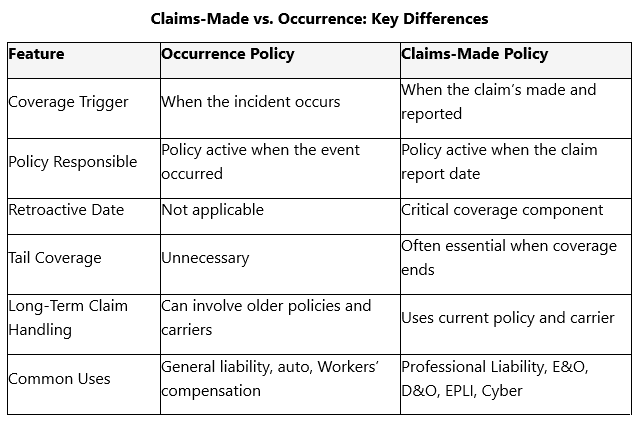
Understanding the difference between claims-made and occurrence insurance policies is critical. Significant uninsured losses occur with misunderstanding claim-triggers.
What Is an Occurrence Insurance Policy?
An occurrence policy provides coverage based on when the covered incident occurred. If a covered event happens during the policy period, the policy in force at that time responds to the claim, even when the claim’s report occurs after policy expiration.
For example, if a customer suffers an injury in 2022 and files a lawsuit in 2026, the occurrence policy that was active in 2022 responds to the claim.
An occurrence policy form works well for simple general liability exposures because of the ease of determining the date of the injury or damage.
Common Occurrence-Based Policies
Standard insurance products using occurrence forms:
-
-
- Commercial General Liability (CGL)
- Business Owners Policies (BOP)
- Workers’ Compensation
- Homeowners Insurance
- Personal Auto Insurance
-
These policies continue protection for covered incidents occurring during the policy period, regardless of when the claim date.
What Is a Claims-Made Insurance Policy?
A claims-made policy provides coverage based on when the claim’s made date, not when the alleged error occurred.
Under a claims-made policy, coverage exists when:
-
-
- An active claims-made policy existed when the act occurred.
- The alleged act occurred after the current policy’s retroactive date (also called the prior acts date).
- The claim report happens during an active policy period or during an applicable Extended Reporting Period (ERP), often referred to as tail coverage.
-
The insurer on the risk when the claim’s made has responsibility for the claim, and the policy form in effect at that time determines coverage.
Why Professional Liability Insurance Uses Claims-Made Forms
Professional liability claims frequently develop over time. An attorney, accountant, consultant, architect, or other professional provides client services spanning multiple policy periods and multiple insurance carriers.
If professional liability insurance uses an occurrence trigger, determining which insurer becomes extremely complicated. Questions frequently arise such as:
-
-
- Which policy period applies?
- Which insurer is responsible?
- Are multiple insurers involved?
- Which policy limits should apply?
- Which policy language governs the claim?
-
The claims-made form eliminates this uncertainty and creates greater predictability for both insureds and insurers.
The Importance of the Retroactive Date
A key component of a claims-made policy is the retroactive date.
The retroactive date establishes how far back the policy covers professional acts. If an alleged error occurred before the retroactive date, there is no coverage, even when policy an active policy exists on the claim report date.
When businesses switch insurance carriers, preserving the original retroactive date becomes essential to avoid coverage gaps.
What Is Tail Coverage?
Tail coverage, formally known as an Extended Reporting Period (ERP) endorsement, allows claims reporting after claims-made coverage expires.
This protection becomes particularly important when:
-
-
- A firm closes
- A professional retires
- A businesses merge
- Continuous claims-made coverage lapses
-
Without an active claims-made policy or an applicable ERP endorsement, no coverage exists for claims reported after the policy terminates, even when the professional services occurred while the policy was active. ,
Common Types of Claims-Made Insurance
Many specialized liability policies use the claims-made coverage trigger, including:
-
-
- Professional Liability Insurance
- Errors & Omissions (E&O) Insurance
- Attorney Malpractice Insurance
- Accountant Professional Liability Insurance
- Directors & Officers (D&O) Liability
- Employment Practices Liability Insurance (EPLI)
- Cyber Liability Insurance
- Fiduciary Liability Insurance
- Environmental Liability Insurance
- Certain Excess and Umbrella Liability Policies
-
Final Thoughts
The difference between claims-made and occurrence insurance policies comes down to one critical question: What triggers coverage?
Occurrence policies use on when the covered event happened. Claims-made policies use the claim report date and require that the alleged act falls after the retroactive date. Understanding these distinctions businesses avoid coverage gaps, manage risk effectively, and ensure claims are reported to the proper insurer.
For professionals understanding the mechanics of claims-made coverage is not simply an insurance technicality. It is an essential part of protecting the firm’s assets and long-term financial security.
Click Here for an Insurance Quote

Contact Me Today
Lee Norcross, MBA, CPCU
California License # 0D87292
L Squared Insurance Agency, LLC ® DBA in California as L2 L Squared Insurance Agency, License # 0L93416
Managing Director, CEO
Lee@L2Ins.com
616-726-7080
