
Why Law Firms with Trust and Fiduciary Departments
Need Professional Liability, Cyber Insurance, and Crime Insurance
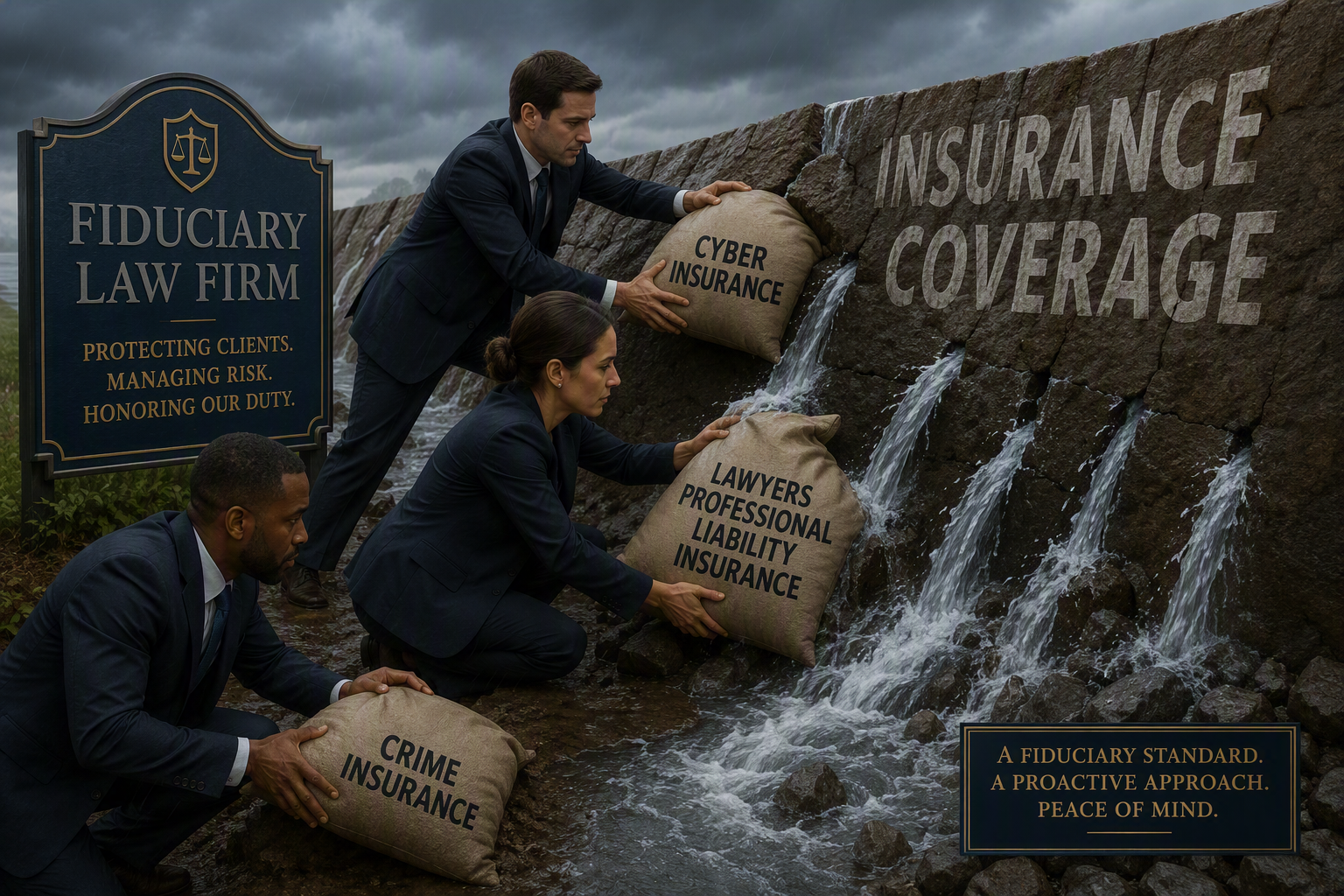
Law firms purchase Lawyers Professional Liability Insurance (LPL), assuming comprehensive protection. Law firms maintaining trust, fiduciary, estate administration, trustee, or escrow departments face addition exposures beyond LPL. Acting in a fiduciary capacity controlling client funds, managing trust assets, disbursing money, and overseeing estates, make attractive targets for employee theft, wire fraud, social engineering scams, cybercriminals, and financial crime schemes. Such firms need LPL, Cyber Insurance, and Crime Insurance working together filling critical coverage gaps.
Why Professional Liability Coverage Is Not Be Enough
LPL protects law firms when clients allege an error, omission, or negligent acts arising from covered legal services. Examples include missed deadlines, drafting mistakes, conflicts of interest, or legal advice that allegedly causes financial harm. However, fiduciary and trust departments create exposures extending beyond covered legal services. Law firms acting as:
-
-
- Trustees
- Executors
- Estate administrators
- Escrow agents
- Guardianship managers
- Fiduciary advisors
-
Provide services while controlling or transferring client funds and assets. Few malpractice insurance policies respond when someone steals, misappropriates, forges, or fraudulently transfers funds. LPL policies exclusions include theft, fraud, conversion, misappropriation of trust account funds. Significant uninsured loss occur from missing funds.
Criminals Target Trust Accounts
Criminals target trust accounts and IOLTA accounts containing substantial client funds. In the same manner that IOLTA accounts tempt trusted employee who:
-
-
- Deposit funds
- Reconcile accounts
- Approve payments
- Process wire transfers
- Issue checks
- Communicate with financial institutions
-
While internal controls mitigate exposure, employees and outside criminals exploit weaknesses. Common loss scenarios include:
-
-
- Employee embezzlement
- Forged checks
- Fraudulent wire instructions
- Business email compromise
- Unauthorized account access
- Social engineering attacks
-
Law firms with fiduciary departments face these exposures when handling client money every day.
Cyber Insurance Provides Digital Threats Coverage
Cybercriminals increasingly target law firm’s confidential client data and financial transactions. Cyber incidents result in:
-
-
- Data breaches
- Ransomware attacks
- System outages
- Privacy violations
- Client notification expenses
- Regulatory investigations
- Reputation damage
-
A Properly endorsed cyber policy addresses 1st and 3rd party coverages. Covered exposures include data breach response services, forensic investigations, ransomware response, business interruption coverage, data restoration, and privacy liability protection. Firms with trust and fiduciary departments, cyber Insurance becomes critical as criminals gain access to funds through compromised email accounts or fraudulent communications rather than physical theft.
Wire Fraud Is a Continuing Threat to Trust and Fiduciary Departments
Few risks concern law firms more than wire fraud. Consider a common scenario. A criminal compromises an email account and sends fraudulent wire instructions that appear legitimate. A staff member processes the transfer, believing the request came from a client or financial institution. Within minutes, hundreds of thousands of dollars vanish.
Professional Liability Insurance rarely reimburses stolen funds because the loss stems from fraud or theft rather than a legal error.
Without specialized Cyber Insurance and Crime Insurance, the law firm may be responsible for replacing the missing funds.
Crime Insurance Fills a Critical Coverage Gap
For firms managing trust assets, crime insurance represents the final layer of protection preventing a catastrophic financial loss. Not covered by LPL and partially covered by cyber insurance, crime Insurance protects against direct financial losses caused by criminal acts including:
-
-
- Employee theft
- Employee dishonesty
- Embezzlement
- Computer fraud
- Funds transfer fraud
- Forgery and alteration
- Social engineering fraud
- Theft of money and securities
- Investigation expenses
-
Employee Theft Remains a Serious Risk
Responsible for managing trust and estate assets, a single embezzlement event creates financial, regulatory, and reputational nightmares. According to a Hiscox Embezzlement Study, employee theft remains a significant threat to organizations of all sizes. The study found:
-
-
- Average losses exceeded $350,000.
- Most schemes continued for more than one year.
- Management-level employees were frequently involved.
- Organizations normally recover only a portion of stolen funds.
-
A Three-Layer Insurance Strategy for Fiduciary Law Firms
Create a comprehensive insurance program addressing the full risk spectrum facing law firms with trust and fiduciary responsibilities. It is understanding the role each policy serves.
-
-
- Professional Liability Insurance – Protects against claims arising from legal services, professional errors, omissions, and negligence.
- Cyber Insurance – Protects against data breaches, ransomware, network security incidents, privacy liability, cyber extortion, and certain cyber-enabled fraud events.
- Crime Insurance – Protects against employee theft, embezzlement, forgery, funds transfer fraud, social engineering fraud, and other direct financial crimes.
-
In Summary
Law firms with dedicated trust and fiduciary departments control client assets, administer estates, manage trust accounts, and move money on behalf of clients, face unique exposures extending beyond legal malpractice coverages. LPL lacks protection against employee theft, cybercrime, wire fraud, or trust account losses. By combining LPL, Cyber Insurance, and Crime Insurance, fiduciary law firms close dangerous coverage gaps and better protect their clients, their reputation, and their financial stability.
Request Quotes For LPL, Cyber & Crime

Contact Me Today
Lee Norcross, MBA, CPCU
California License # 0D87292
L Squared Insurance Agency, LLC ® DBA in California as L2 L Squared Insurance Agency, License # 0L93416
Managing Director, CEO
Lee@L2Ins.com
616-726-7080