
Ferguson v Aon Risk Services Companies, Inc. (7th Cir. 2026) – 3rd Party Beneficiary Rights
The U.S. Court of Appeals for the Seventh Circuit issued an important insurance and contract law decision in Ferguson v Aon Risk Services Companies, Inc., No. 24-2017 (7th Cir. Aug. 13, 2026). The ruling reinforces long-standing principles governing third-party beneficiary claims, the scope of insurance broker duties, and the application of Illinois statutes of limitation. [law.justia.com], [caselaw.findlaw.com]
For insurance professionals, brokers, litigators, and risk management specialists, the decision provides guidance on a non-contracting party pursuing claims against an insurance broker.
Background of the Dispute
The plaintiffs, including Robert D. Ferguson and related entities, acquired Clarendon America Insurance Company rights and Clarendon National Insurance Company to pursue claims arising from losses connected to a failed reinsurance program. Clarendon alleged that significant losses occurred after Raydon Underwriting Management Company, a subsidiary of Stirling Cooke Brown Holdings (SCB), recommended participation in a poorly structured London Market reinsurance program. [law.justia.com], [caselaw.findlaw.com], [app.midpage.ai]
Aon Risk Services assisted SCB in procuring professional liability insurance coverage. The plaintiffs argued that Aon failed to notify SCB’s professional liability insurers of Clarendon’s claims. After the insurers denied coverage because of untimely notice, the plaintiffs sought to hold Aon responsible. [law.justia.com], [caselaw.findlaw.com]
The plaintiffs brought claims for:
-
-
- Breach of contract
- Professional negligence
-
The U.S. District Court for the Northern District of Illinois dismissed the negligence claim and later granted summary judgment to Aon on the contract claim. The plaintiffs appealed. [law.justia.com], [isba.org]
The Seventh Circuit Affirms Judgment for Aon
The Seventh Circuit affirmed the district court’s ruling in full concluding that the plaintiffs could not prevail on either their contract or negligence theories. [law.justia.com], [caselaw.findlaw.com], [isba.org]
The opinion focused on three key issues:
-
-
- Whether Clarendon qualified as a third-party beneficiary of agreements between Aon and SCB.
- Whether Aon owed a professional duty to Clarendon.
- Whether the claims were timely under Illinois law.
-
Third-Party Beneficiary Status: The Court Said No
Despite not being party to the agreements between AON & SCB could Clarendon enforce those agreements.
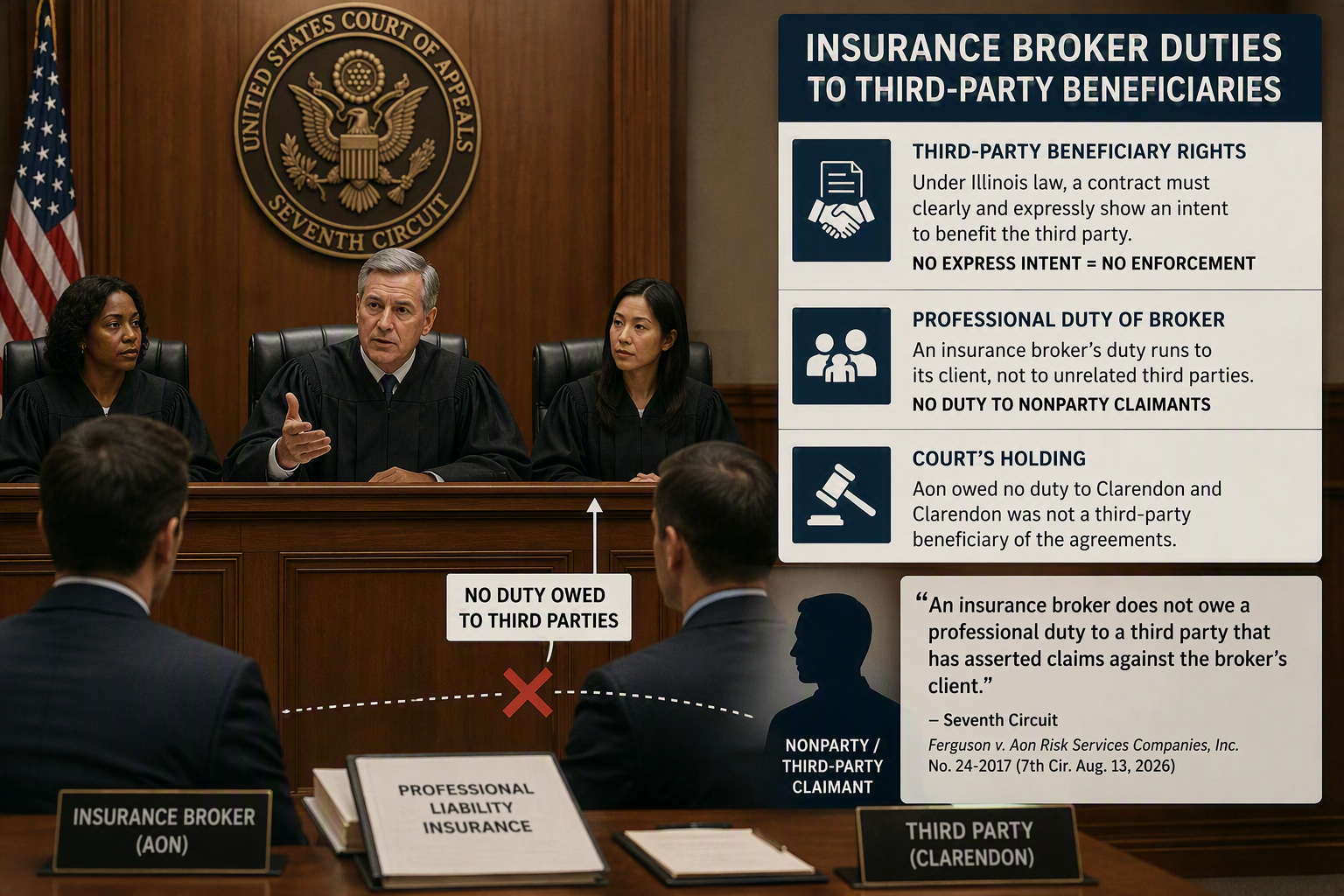
Under Illinois law, courts presume that contracting parties intend their agreements to benefit only themselves. A third party may enforce a contract only when the contracting parties clearly and explicitly intend to benefit that third party. [gavelocity.com], [isba.org]
The Seventh Circuit found no such intent in the agreements at issue. Although the contracts referenced entities with which SCB conducted business, the court determined that the language did not expressly identify Clarendon as an intended beneficiary. Consequently, Clarendon could not assert breach-of-contract claims based on those agreements. [law.justia.com], [gavelocity.com]
No Professional Negligence Duty Owed to Clarendon
The plaintiffs also alleged that Aon negligently failed to notify SCB’s insurers of Clarendon’s claims.
The Seventh Circuit rejected this argument explaining that an insurance broker ordinarily owes professional duties to its client, not to unrelated third parties. Here, Aon represented SCB, not Clarendon. [gavelocity.com], [caselaw.findlaw.com]
No legal authority extents a broker’s duty to a third party that had asserted claims against the broker’s client. Clarendon failed to establish the duty required for a professional negligence claim. [gavelocity.com], [law.justia.com]
Statute of Limitations Provided an Additional Barrier
The Seventh Circuit also held that Illinois law time-barred the plaintiffs’ claims determining that the plaintiffs possessed sufficient information putting them on inquiry notice years before they filed suit. Because the plaintiffs failed bringing claims within the applicable limitations period, the statute barred them from proceeding. [gavelocity.com], [law.justia.com]
Why Ferguson v Aon Matters
The Ferguson decision carries implications well beyond the parties involved. The ruling strengthens key legal principles:
-
-
- Strict Interpretation of Third-Party Beneficiary Claims – Courts continue to require clear contractual language before allowing a nonparty to enforce an agreement. Businesses should draft beneficiary provisions carefully if they intend to create enforceable rights. [gavelocity.com], [law.justia.com]
- Defined Limits on Insurance Broker Liability – The decision confirms that insurance brokers owe duties only to their clients absent special circumstances or explicit obligations. [gavelocity.com], [caselaw.findlaw.com]
- Continued Importance of Timely Claims – Parties pursuing insurance-related litigation must act promptly once they possess information suggesting potential wrongdoing. Delayed action can prove fatal to otherwise viable claims. [gavelocity.com]
-
Final Thoughts
The Ferguson v Aon Risk Services Companies, Inc. decision reinforces core principles of Illinois contract and professional negligence law holding that Clarendon was not an intended third-party beneficiary of the agreements between Aon and SCB, that Aon owed no professional duty to Clarendon, and that the claims were untimely. These findings resulted in a complete victory for Aon providing guidance for future disputes involving insurance brokers, contract enforcement, and professional liability. [law.justia.com], [caselaw.findlaw.com], [isba.org]
Sources: Seventh Circuit opinion in Ferguson v. Aon Risk Services Companies, Inc., No. 24-2017 (Aug. 13, 2026), as summarized by Justia, FindLaw, and Illinois State Bar Association case reports. [law.justia.com], [caselaw.findlaw.com], [isba.org]
Request an Insurance Broker or Agency Quote

Contact Me Today
Lee Norcross, MBA, CPCU
California License # 0D87292
L Squared Insurance Agency, LLC ® DBA in California as L2 L Squared Insurance Agency, License # 0L93416
Managing Director, CEO
Lee@L2Ins.com
616-726-7080