
NYC Bar Formal Opinion 2026-2
Using AI to Record, Transcribe, and Summarize Non-Client Conversations
Artificial intelligence meeting assistants, transcription tools, and automated note-taking applications are commonplace in legal practice. With increasing adoption concerns arise regarding confidentiality, data governance, competence, and professional responsibility.
On August 5, 2026, the New York City Bar Association Committee on Professional Ethics issued Formal Opinion 2026-2: Ethical Issues Affecting Use of AI to Record, Transcribe, and Summarize Conversations with Persons Who Are Not Clients. The opinion extends principles previously established in Opinion 2024-5 (Generative AI in the Practice of Law) and Opinion 2025-6 (AI Recording of Client Conversations) to interactions with non-clients. [nycbar.org], [nycbar.org]
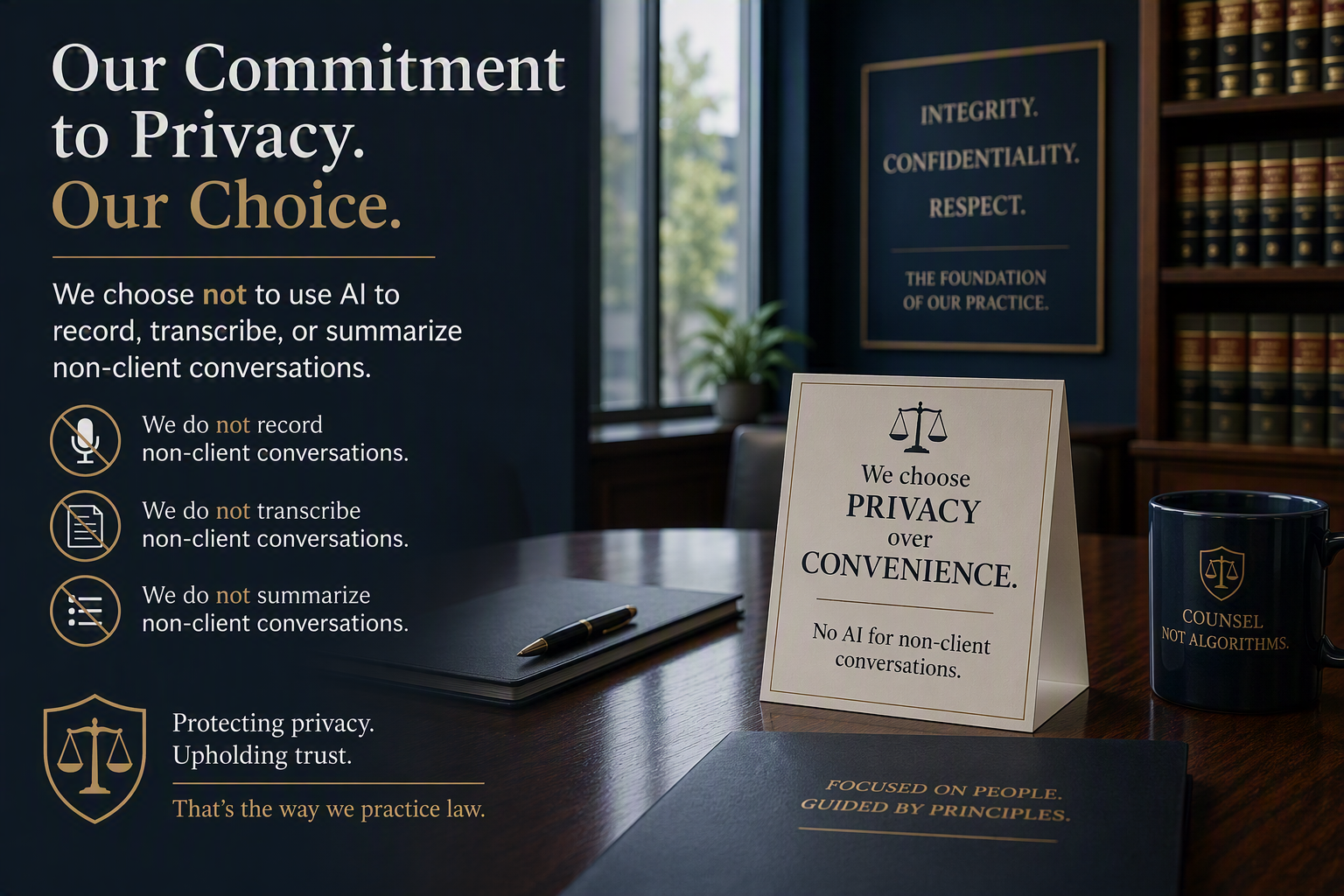
While AI improves efficiency, lawyers must carefully weigh the ethical, legal, and strategic consequences before recording conversations.
Key Takeaways from Formal Opinion 2026-2
The Committee concluded that attorneys should:
-
-
- Obtain the consent of all parties before recording a conversation.
- Carefully consider whether recording, transcribing, or summarizing a conversation is tactically appropriate.
- Understand how AI tools collect, store, process, and share information.
- Review AI-generated transcripts and summaries for accuracy.
- The potential ethical issues of AI recordings normally exceed their advantages. [nycbar.org], [nycbar.org]
-
The most significant takeaway is the Committee’s recommendation that attorneys should avoid recording conversations as the default practice unless there is a compelling reason to do so because of the ethical and tactical risks involved. [nycbar.org], [abajournal.com]
Why Consent Matters
Although recording laws vary by jurisdiction, the Committee recommends obtaining consent from all participants before recording conversations. This approach goes beyond minimum legal requirements in some jurisdictions and reflects a risk-management mindset designed to avoid potential ethical issues, allegations of deception, or disputes concerning the use of AI-generated records. [nycbar.org], [nycbar.org]
Law firms must recognize that compliance necessitates thorough analysis:
-
-
- State recording laws.
- Professional conduct rules.
- Client confidentiality obligations.
- Data privacy and cybersecurity requirements.
-
Because these rules differ by jurisdiction, lawyers must review the applicable authority before they adopt AI note-taking technologies.
The “Prospective Client Paradox”
A notable section of Opinion 2026-2 addresses conversations with prospective clients.
The Committee describes a “paradox” when deciding whether to record an intake discussion. On one hand, a recording may help an attorney evaluate a potential matter and document the reasons for accepting or declining representation. On the other hand, maintaining recordings or transcripts of prospective client communications creates future conflict-of-interest concerns if the retained information becomes accessible within the firm. [nycbar.org], [abajournal.com]
This guidance highlights the importance of implementing clear retention, storage, and access-control policies whenever using AI tools during intake or consultation calls.
Ethical Risks Across Different Practice Settings
The opinion discusses multiple scenarios involving non-client communications, including:
-
-
- Co-Counsel Communications – When communicating with co-counsel, law firms must actively protect privileged and confidential information. Securely maintaining AI-generated recordings and transcripts and restrict access only to those involved in joint representation. [abajournal.com], [nydailyrecord.com]
- Opposing Counsel and Settlement Discussions – The Committee notes that privilege and confidentiality concerns arise during settlement negotiations and mediations. When using AI tools ensure that the protections surrounding confidential do not compromise settlement communications. [abajournal.com]
- Witnesses, Experts, and Investigators – Conversations involving witnesses, experts, investigators, and other third parties require similar scrutiny. Evaluate whether creating a permanent AI-generated record creates discoverability concerns, strategic disadvantages, or unnecessary confidentiality risks. [nycbar.org], [nycbar.org]
-
Competence and Oversight Remain Essential
Consistent with earlier AI ethics guidance, Opinion 2026-2 reinforces that lawyers must understand the technology they choose to use. Competence includes knowing:
-
-
- How to activate recordings.
- Is data stored locally or in the cloud?
- Who has access to recordings and transcripts?
- Whether vendor systems use information for training or other purposes.
- How to verify the accuracy of AI-generated outputs. [nycbar.org]
-
Attorneys cannot delegate their professional obligations to technology. Before relying on an AI-generated summary the lawyer must review. [nycbar.org]
Practical Considerations for Law Firms
Formal Opinion 2026-2 reflects a trend among ethics regulators: encouraging responsible AI adoption while emphasizing professional judgment.
Law firms should consider:
-
-
- Creating AI governance policies.
- Establishing consent procedures for recorded conversations.
- Vetting AI vendors for security and confidentiality protection.
- Implementing retention and deletion protocols.
- Training attorneys and staff on ethical AI use.
- Evaluating whether recording is necessary before activating AI note-taking tools.
-
The opinion suggests that traditional notetaking presents fewer risks than creating AI generated discoverable recordings and transcripts.
In Summary
Formal Opinion 2026-2 does not prohibit lawyers from using AI-powered recording, transcription, or summarization tools. Instead, it underscores that these technologies require careful consideration, informed consent, technological competence, and ongoing professional oversight.
The Committee’s strongest message is the simplest: while AI offers convenience and efficiency, attorneys do not assume that every conversation needs a recording. Often the safest and most strategic approach is not creating a recording at all. [nycbar.org], [abajournal.com]
Get An Attorney Malpractice Insurance Quote
Please Note: Unless there is a current countersigned engagement letter on file with Barron & Newburger, P.C., BNPC is not your lawyer.


Sources: New York City Bar Association Formal Opinion 2026-2; New York City Bar Association Committee on Professional Ethics; public reporting by ABA Journal and NY Daily Record discussing the opinion. [nycbar.org], [abajournal.com], [nydailyrecord.com] ; Westfield Tip of the Month – New Ethics Opinion on Using AI to Record non-Client Conversations (August 2026)