
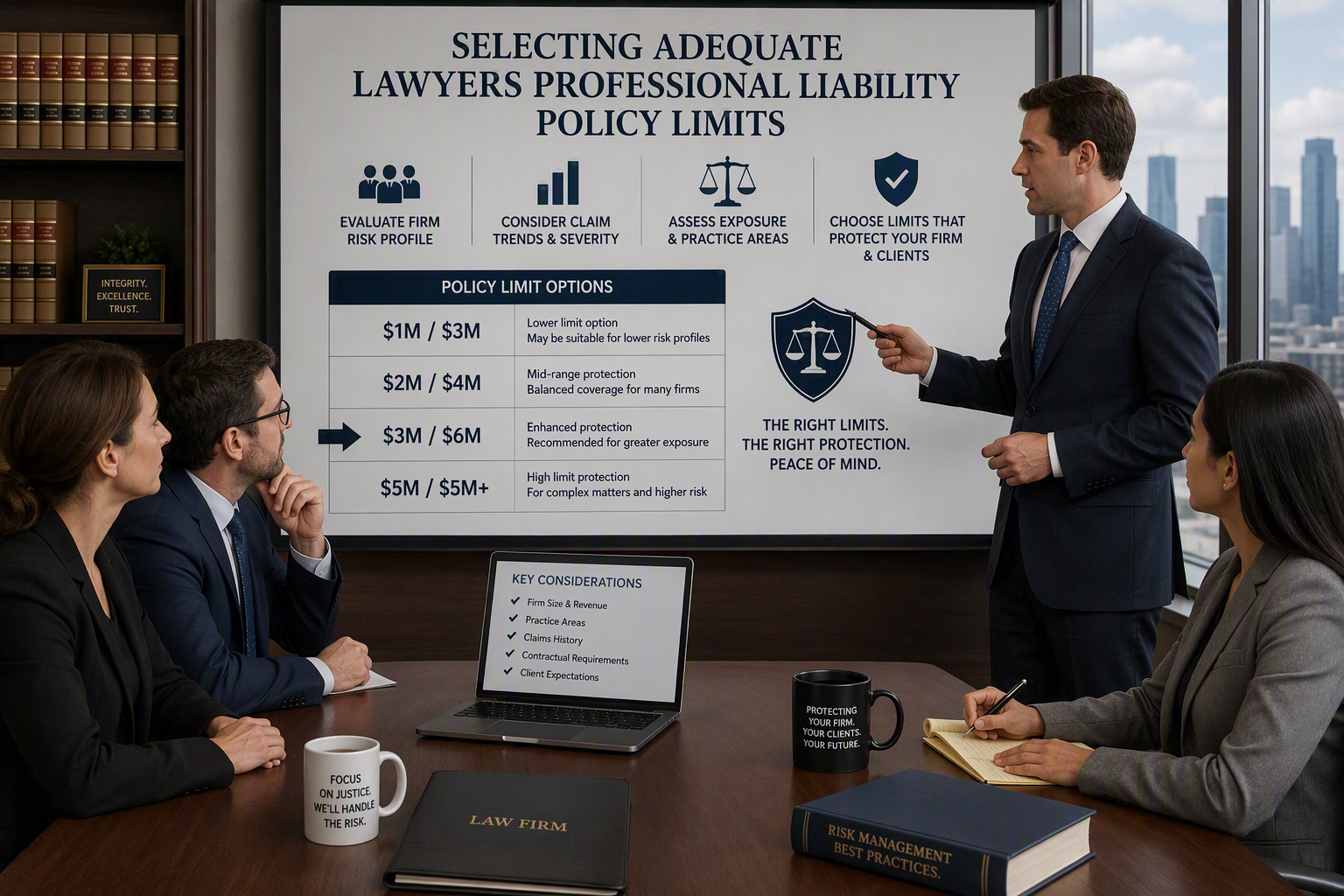
What Lawyers Professional Liability Insurance Limits Should Your Firm Carry?
Law firms ask, “What lawyers professional liability insurance limits do we need?” The answer depends. Each law practice faces distinctive risks, serves different client types, and with cases of varying worth, all factors that influence the professional liability limit needed.
Choosing inadequate limits leaves a firm exposed to substantial out-of-pocket costs. On the other hand, purchasing limits that exceed your actual exposure results in unnecessary insurance expenses. Knowing your firm’s maximum malpractice claim exposure is key.
There Is No Universal Liability Limit for Law Firms
Attorneys assume practice areas solely determine liability limits. Practice area provides an incomplete picture of a firm’s exposure. A criminal defense attorney representing high-profile clients faces significantly different risks from routine misdemeanor cases. Likewise, plaintiff attorneys work on cases ranging from modest claims to matters involving damages in the tens of millions of dollars.
The same principle applies across every practice area. Estate planning, business transactions, family law, real estate, and litigation practices incur malpractice claims with vastly different financial consequences.
Consider the Largest Potential Exposure, Not the Average Case
A mistake attorneys make when evaluating malpractice insurance limits wrongly focus on their average case value. The more important question is: What is the value of the largest or potentially largest matter your firm handles?
For example:
-
-
- A personal injury firm routinely gets smaller value cases but occasionally accepts catastrophic injury cases.
- An estate planning attorney normally works with modest estates except for certain high-net-worth clients.
- A business attorney advises small companies business transactions but occasionally advises on significant commercial transactions.
-
A single error on a high-value matter can create a malpractice exposure far beyond what average case values might suggest.
Defense Costs Matter
Claim costs consist of potential settlements and/or judgments plus defense costs. Sizable defense costs eat limits when a legal malpractice claim proceeds to trial.
Attorney malpractice cases incur significant defense expenses, with average trial defense costs exceeding $75,000 to $80,000 according to insurers.
-
-
- Certain lawyers professional liability policies include defense costs within the policy limits (CEIL). This means every dollar spent defending a claim reduces the amount available to pay damages. The result is that an “adequate” policy limit exhausts sooner than expected.
- Other insurers have separate sub-limits for defense costs (CEOL).
-
When determining appropriate limits, account for both potential indemnity payments and defense expenses.
Understanding Per Claim and Aggregate Limits
Professional liability policies contain two key liability limits:
-
-
- Per Claim Limit – The per claim limit represents the maximum amount the insurer will pay for damages and claim expenses arising from a single malpractice claim.
- Aggregate Limit – The aggregate limit represents the maximum amount the insurer will pay for all covered claims during a policy period. Firms focus heavily on the per claim limit, but the aggregate limit is equally important. A single procedural mistake that affects multiple clients generates multiple claims. Certain practice areas the aggregate limit is more important than others. Collection practices, for example, when the same error or violation occurs hundreds of time generates hundreds of claims.
-
Client and Regulatory Requirements
In addition to evaluating potential malpractice exposures, consider external requirements. Certain states establish minimum insurance standards based on firm size or other criteria. Certain clients, referral networks, and professional panels require attorneys to carry specific minimum limits before engagement. ,
Failing to meet these requirements can limit business opportunities and create compliance concerns.
Why Underinsurance Can Be Costly
If a malpractice claim exceeds your policy limits, the insurer’s payment obligation ends at the policy limit. Any remaining defense costs, settlements, or judgments become the firm’s responsibility.
Selecting limits is a risk management decision rather than simply an insurance purchasing decision. Underinsuring a firm leads to serious financial consequences impacting both the firm’s operations and its long-term viability.
Think Beyond Today’s Practice
With claims-made lawyers professional liability insurance claims are made against the in-force policy. Your past acts are your future claims.
As your practice evolves, your insurance limits should evolve. Periodically review your client base, case values, and practice concentrations ensuring limits remain aligned with current and past exposures.
The Bottom Line
Determining the right lawyers professional liability insurance limits requires more than selecting a standard coverage option. Determine the largest cases handled, consider defense costs, assess the likelihood of multiple claims, review client or regulatory requirements, and understand the consequences of exhausting policy limits. With the right policy limits consider lawyers professional liability sleep insurance.
Request a Legal Malpractice Quote

Contact Me Today
Lee Norcross, MBA, CPCU
California License # 0D87292
L Squared Insurance Agency, LLC ® DBA in California as L2 L Squared Insurance Agency, License # 0L93416
Managing Director, CEO
Lee@L2Ins.com
616-726-7080