
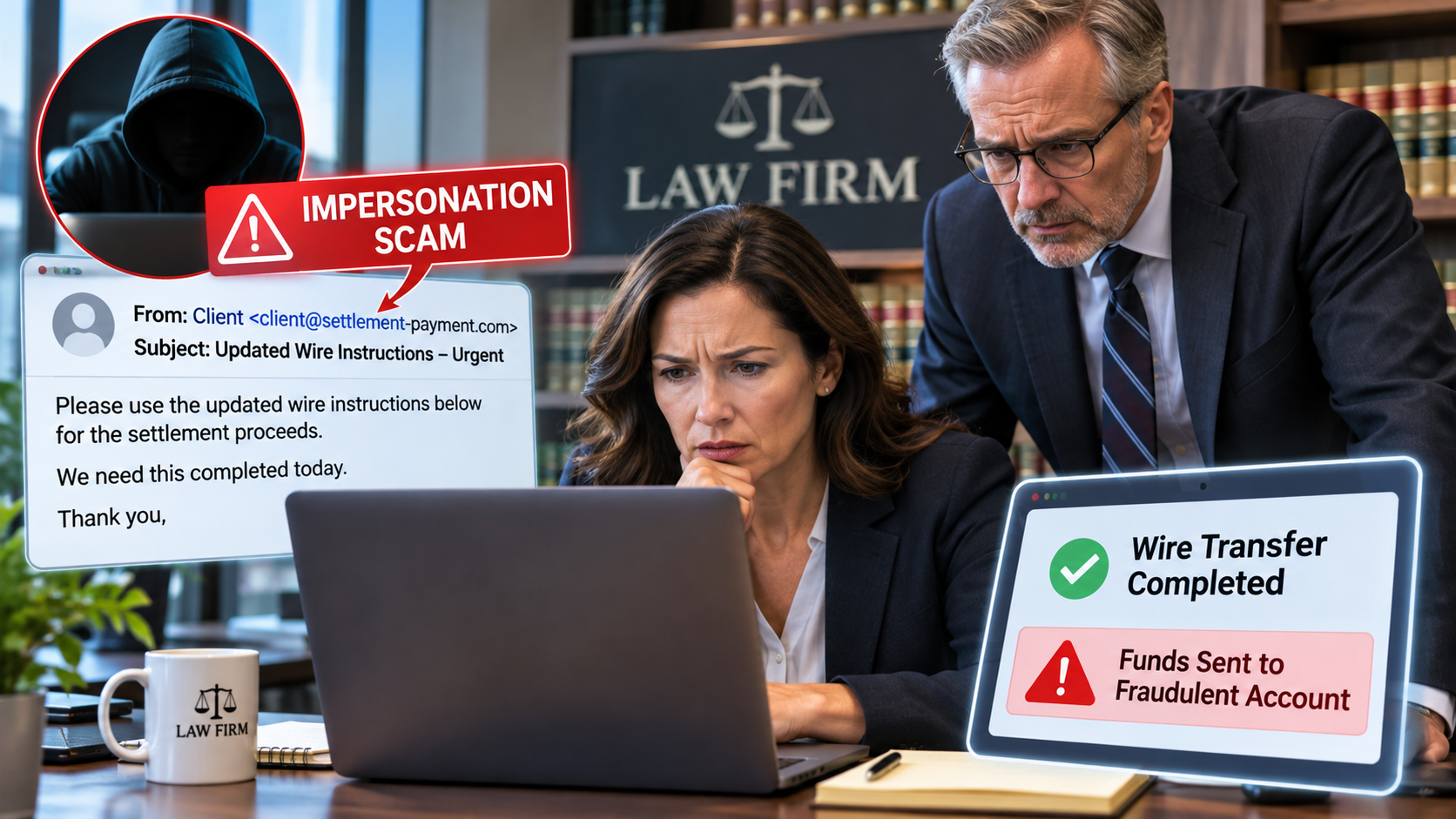
Impersonation Scams A Growing Threat to Law Firms
Impersonation scams threaten businesses, consumers, and professional service firms. Criminals pose as trusted individuals or organizations stealing money, obtaining confidential information, and redirecting financial transactions. Nearly 60% of Allstate scam cases handled between January and September 2026 involved impersonation. These findings highlight the importance of recognizing fraudulent communications before criminals convince victims to transfer funds or disclose sensitive information.
Impersonation scams present serious risks for attorneys that routinely handle confidential client information, settlement proceeds, real estate transactions, and trust account funds. When criminals impersonate clients, attorneys, financial institutions, and other trusted parties failing to recognize these schemes cause financial losses, client disputes, reputational damage, and potential professional liability claims.
How Do Impersonation Scams Target Law Firms?
As attorneys frequently handle substantial financial transactions and confidential information make law firms attractive targets.
-
-
- Fraudulent Wire Transfer Instructions – Criminals impersonate clients, attorneys, title companies, or financial institutions provide fraudulent wiring instructions.
- Business Email Compromise – Criminals gain access to legitimate email accounts or create deceptive email addresses that closely resemble those of trusted parties and then send fraudulent payment instuctions.
- Client Impersonation – A criminal contacts a law firm pretending to represent an existing client. The impersonator requests confidential documents, changes to account information, or transfers funds from a client trust account.
- Attorney and Law Firm Impersonation – Criminals also impersonate attorneys and law firms when communicating with clients by sending fraudulent invoices, demanding payments, or providing altered settlement instructions.
-
Does Lawyers Professional Liability Insurance Cover Impersonation Scams?
Lawyers professional liability insurance may not cover financial losses resulting from impersonation scams. A lawyers professional liability policy responds to covered claims alleging negligent acts, errors, or omissions arising from the firm’s professional services. Law firms should never assume that their malpractice insurance automatically protects them against every type of fraudulent financial transaction.
Can Cyber Insurance Cover Impersonation Fraud?
Cyber insurance provides important protection against certain losses involving compromised computer systems, fraudulent communications, and cyber-related incidents. However, not every cyber insurance policy includes the same coverage. Certain policies provide coverage for social engineering fraud or fraudulent funds transfers through specific endorsements. Other policies exclude certain voluntary transfers or impose separate limits and conditions. Depending on the policy language, the insurer may distinguish between an unauthorized electronic transfer and a transfer that an authorized employee approved after being deceived. This distinction can determine whether coverage applies.
Important Cyber Insurance Coverage Questions
Law firms should ask their insurance agent:
-
-
- Does the policy include social engineering fraud coverage?
- Does it cover fraudulent wire transfers?
- Does coverage apply when an employee voluntarily authorizes a payment after receiving fraudulent instructions?
- Does the policy require independent verification of payment changes?
- What limits and deductibles apply to social engineering claims?
- Does the policy exclude certain types of financial transactions?
-
Crime Insurance
As not all fraudulent transfers involve a computer, a properly endorsed crime insurance policy provides additional protection for fraudulent transfer losses. Lawyers professional liability, cyber insurance, and commercial crime insurance provide different protections. Avoid potential coverage gaps by coordinating these policy coverages.
Seven Ways Law Firms Can Reduce Impersonation Scam Risks
-
-
- Independently Verify Wire Transfer Instructions
- Establish Dual Authorization Procedures
- Train Employees to Recognize Impersonation Attempts
- Implement Multifactor Authentication
- Protecting Client Trust Accounts
- Educating Clients About Payment Fraud
- Review Insurance Coverage Annually
-
For more information on protecting your firm from impersonation scams Contact Us.

Contact Me Today
Lee Norcross, MBA, CPCU
California License # 0D87292
L Squared Insurance Agency, LLC ® DBA in California as L2 L Squared Insurance Agency, License # 0L93416
Managing Director, CEO
Lee@L2Ins.com
616-726-7080

Sources and Additional Reading
- Allstate Corporation — 2026 impersonation scam findings, covering January through September 2026.
- Carrier Management — November 9, 2026, reporting on Allstate’s impersonation scam statistics.
- Insurance Business America — Reporting on impersonation fraud and potential gaps in cyber insurance coverage.
Disclaimer: This article provides general insurance and risk management information. Actual coverage depends on the terms, conditions, exclusions, endorsements, and limits of the applicable insurance policies. Coverage determinations require an evaluation of the specific facts and policy language.