
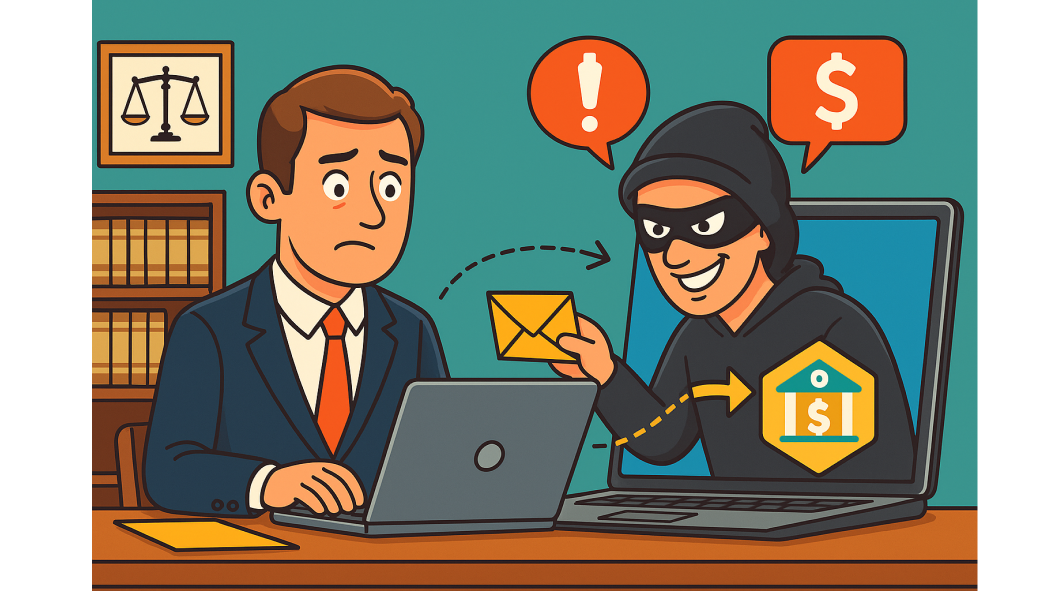
Law Firm Wire Fraud Prevention
Law firms regularly manage sensitive financial transactions involving settlements, real estate closings, loans, retainers, and other client matters. That access to money makes attorneys and their clients attractive targets for cybercriminals.
Effective law firm wire fraud prevention requires more than securing your firm’s email system. Criminals can compromise a client’s email account, financial institution, another law firm, title company, or other third party involved in a transaction. Once criminals gain access, they can monitor communications and wait for the right opportunity to redirect funds.
Understanding how these scams work and establishing procedures to verify financial instructions can help law firms protect themselves and their clients.
How Email and Wire Fraud Target Law Firms
Cybercriminals often use compromised or fraudulent email accounts to impersonate attorneys, clients, financial institutions, or other parties involved in a transaction. They may monitor email conversations for information about an upcoming transfer of funds.
The criminal can learn important transaction details, including the amount of money involved, the parties participating in the transaction, and when someone expects to receive payment instructions. The fraudster then uses that information to make a fraudulent email appear legitimate.
For example, a criminal may send new wiring instructions shortly before a scheduled transfer. The fraudulent instructions direct the money to an account controlled by the criminal rather than the intended recipient.
Once the victim sends the money, criminals quickly move the funds to other accounts, making recovery difficult.
Business Email Compromise
A fraudulent email does not always look obviously fraudulent.
Cybercriminals may compromise a legitimate email account and send instructions directly from it. In other cases, they create an email address or domain that closely resembles the legitimate sender’s address. A small spelling change or an extra character can be easy to overlook during a busy transaction.
Attorneys and law firm employees should carefully review emails involving money transfers, particularly when a message changes previously established payment instructions.
Recognize the Warning Signs of Wire Fraud
Strong law firm wire fraud prevention starts with recognizing suspicious activity before anyone transfers money.
Pay particular attention when someone:
-
-
- Changes previously provided bank or routing information.
- Requests a wire transfer when the parties previously agreed to use a check or another payment method.
- Sends financial instructions from an unfamiliar or personal email address.
- Uses an email address that differs slightly from the address you normally recognize.
- Introduces an unexpected contact into the transaction.
- Suddenly changes established payment procedures.
- Pressures your firm to complete a transfer quickly.
- Sends instructions that contain unusual spelling, formatting, or language.
-
One unusual detail may not prove that fraud is occurring. However, an unexpected change involving the destination of client funds should always trigger additional verification.
Verify Wire Instructions by Phone Before Sending Funds
One of the most important safeguards is also straightforward: independently verify wire instructions before transferring money.
When your firm receives new or changed wire instructions, call the intended recipient using a phone number your firm already knows and trusts. Do not rely on a telephone number contained solely in the email requesting the transfer.
Confirm the account information and the legitimacy of the request directly with the recipient before releasing funds. Law firms should also encourage clients and other transaction participants to follow the same procedure.
This verification step creates an additional layer of protection when criminals gain access to email communications.
Create a Law Firm Wire Fraud Prevention Procedure
Law firms can strengthen their defenses by establishing a consistent process for handling electronic funds transfers.
Require employees to independently verify new or changed wire instructions, document that verification, and escalate suspicious requests before releasing funds. Firms should also educate attorneys and staff about phishing, fraudulent domains, compromised email accounts, and other common signs of business email compromise.
Most importantly, employees should understand that an email appearing to come from a trusted person does not automatically make the instructions legitimate.
Consistent procedures can help turn verification from an optional precaution into a routine part of every transaction.
Cybersecurity Extends Beyond Your Law Firm
Even strong internal cybersecurity controls cannot eliminate every source of risk.
A law firm’s systems may remain secure while a criminal compromises the email account of a client, bank, title company, opposing counsel, or another participant. Because financial transactions often involve multiple parties, a security weakness anywhere in the communication chain can create an opportunity for fraud.
Law firms should therefore combine cybersecurity controls with procedures designed to verify the authenticity of financial requests.
Does Cyber Liability Insurance Protect Law Firms?
Preventive controls can reduce risk, but no cybersecurity strategy eliminates it entirely. Law firms should also evaluate whether their insurance program appropriately addresses their cyber exposures.
Cyber liability insurance may provide important protection for certain cyber incidents, subject to the terms, conditions, exclusions, limits, and deductibles of the individual policy. Because coverage can differ significantly among insurers and policies, law firms should review their coverage with an insurance professional.
At L Squared Insurance Agency, we work with law firms to evaluate professional liability and cyber insurance options and better understand the risks associated with their practices.
Protect Your Law Firm Before the Next Wire Request Arrives
Cybercriminals rely on speed, trust, and convincing impersonation. Law firms can make those tactics less effective by slowing down financial transactions long enough to independently verify instructions.
Make law firm wire fraud prevention part of your firm’s standard operating procedures. Train your team to recognize suspicious emails, establish clear verification requirements, and confirm new or changed wire instructions through a trusted communication channel before releasing funds.
Taking time to verify a request could prevent a significant financial loss.
Need help evaluating your firm’s cyber liability exposure? Contact L Squared Insurance Agency to discuss cyber liability insurance options for your law firm.

Contact Me Today
Lee Norcross, MBA, CPCU
California License # 0D87292
L Squared Insurance Agency, LLC ® DBA in California as L2 L Squared Insurance Agency, License # 0L93416
Managing Director, CEO
Lee@L2Ins.com
616-726-7080