
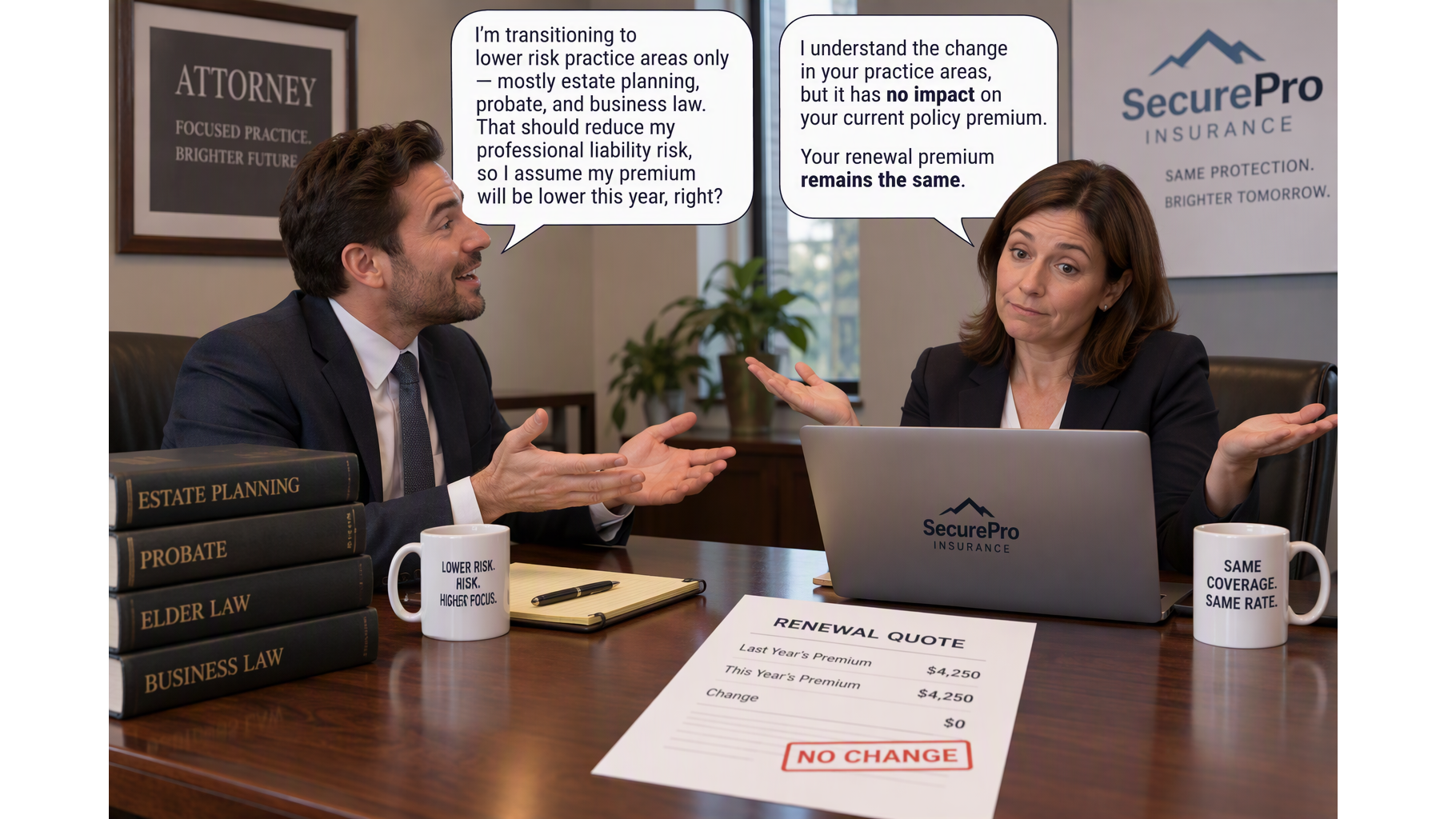
Will Changing Practice Areas Lower Your Attorney Malpractice Insurance Premium?
Changing Practice Areas Will Not Immediately Lower Your Attorney Malpractice Insurance Premium
An attorney decides to move away from higher-risk practice areas focusing on lower-risk work. Naturally, the attorney expects the malpractice insurance premium to decrease.
But there is an important catch: changing practice areas going forward does not eliminate the malpractice exposure from work you have already performed.
That is why changing your practice affects future renewal premiums but will not reduce the premium on your current policy.
Attorney Malpractice Insurance Looks at What You Have Done
When completing an attorney malpractice insurance application, pay close attention to how the insurer asks about your areas of practice.
The application asks about the legal work you performed during the previous year, not what you intend to do during the upcoming year.
For example, an attorney might currently divide a practice 50/50 between practicing law and mediation. The attorney now plans to shift to 90% or 95% mediation or even stop practicing law entirely.
That change eventually affects how an insurer views the practice. However, a plan to change does not alter what the attorney did during the period covered by the renewal application.
Practice area changes during the new policy year impacts subsequent renewal premiums.
Why Doesn’t a Lower-Risk Practice Immediately Reduce the Premium?
Consider how claims-made attorney malpractice insurance works.
An attorney can receive a malpractice claim today arising from legal services performed years earlier. If the policy provides prior acts coverage, coverage extends back to eligible professional services performed after the applicable prior acts date, subject to all policy terms and conditions.
In other words, the insurer covers not only the work you plan to perform tomorrow but the work you did in the past.
Your Claims-Made Policy Covers Your Past Act.
Suppose an attorney historically works in high risk practice areas but decides to perform only a lower-risk area starting with the new policy period. The attorney might ask:
“If I’m no longer doing that higher-risk work, why am I still paying a premium based on it?”
Because the potential claims arising from the attorney’s previous work did not disappear when the attorney changed practice areas.
Your Future Intentions May Differ
Insurers need accurate information about an attorney’s actual practice.
If you tell an insurer that you plan to perform 100% criminal defense, mediation, or another area during the coming year, circumstances could change. You take a case outside those practice area months later.
Your actual practice history gives the insurer concrete information rather than a prediction.
The key lesson remains the same:
Complete your malpractice application based on what the application asks, not what you expect your practice to look like in the future.
Could Changing Practice Areas Lower Your Premium Later?
Yes. A genuine change in your practice potentially affects future underwriting and premiums.
The important word is future.
Consider this simple example:
-
-
- Last year: You performed multiple practice areas.
- Current renewal: You accurately report those practice areas on the application.
- Coming year: You eliminate or dramatically reduce one practice area.
- Next renewal: You report what you did during that period.
-
The insurer can then evaluate the changed practice based on the information requested in its application.
Of course, changing practice areas does not guarantee a lower premium. Insurers consider multiple underwriting factors, and each carrier applies its own eligibility and rating criteria.
Do Not Sacrifice Prior Acts Coverage Just to Lower Your Premium
A lower premium can become expensive if the change creates a coverage gap for previous legal work.
Before replacing or canceling an attorney malpractice policy, determine what happens to your prior acts coverage. Compare more than the premium.
Ask:
-
-
- Will my prior acts date remain the same?
- Will the new policy cover my previous legal work?
- Have the limits or deductible changed?
- Does the new policy contain different exclusions?
- Will changing insurers create any gap in coverage?
- What extended reporting period options are available if I stop practicing?
-
Saving money should never come at the expense of unknowingly losing protection for past professional services.
Changing practice areas does not erase your prior malpractice exposure.
If your renewal application asks what you did during the previous year, accurately report that work. Do not substitute what you plan to do during the upcoming year simply because the new practice mix lowers the premium.
Changing your practice during the new policy year becomes relevant when the insurer asks about that period at your next renewal.
Before changing or canceling coverage, talk with an experienced professional liability insurance agent about your prior acts coverage and the potential impact on future premiums.
Get Lawyers Liability Insurance Malpractice Insurance Quote

Contact Me Today
Lee Norcross, MBA, CPCU
California License # 0D87292
L Squared Insurance Agency, LLC ® DBA in California as L2 L Squared Insurance Agency, License # 0L93416
Managing Director, CEO
Lee@L2Ins.com
616-726-7080