
Are your Lawyers Professional Liability Limits Adequate?
When purchasing legal malpractice insurance are the policy limits truly adequate to protect the firm when a significant claim arises. As legal malpractice verdicts, settlements, and defense costs continue to increase, carrying insufficient limits creates substantial financial exposure for attorneys and their firms.
In the case of Westport Insurance Company v. Mylonas demonstrated why selecting appropriate professional liability limits deserves careful consideration.
Inadequate Malpractice Limits Hidden Risks
Obtain adequate liability limits sufficient for their clientele. A policy’s stated limit may adequate on paper, but policy endorsements can significantly reduce the amount available to pay a claim.
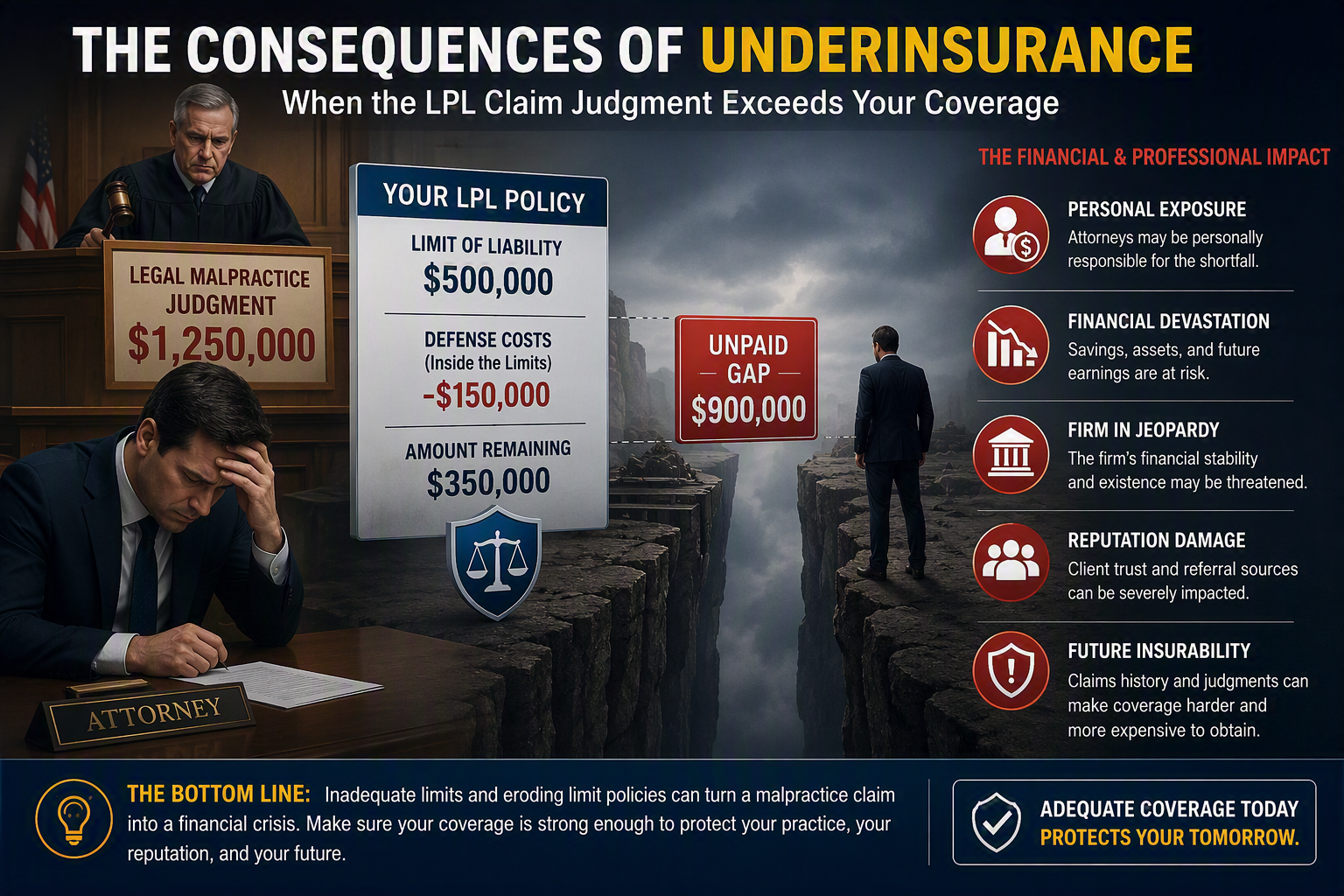
With a Claims Expenses Inside the Limits (CEIL) policy, also known as an “eroding limits” or “burning limits” policy defense costs reduce the available liability limit. Every dollar spent defending the claim decreases the amount remaining to satisfy a settlement or judgment.
A Real-World Example: Westport Insurance Company v. Mylonas
In the Mylonas case, the law firm carried a legal malpractice policy with a $500,000 per claim limit and a $1,000,000 aggregate limit. The CEIL policy eroded limits, meaning defense expenses reduced the available insurance proceeds. The underlying malpractice lawsuit resulted in a judgment of approximately $525,000 against the attorney. However, because defense costs eroded the limits, less than $420,000 remained available to satisfy the judgment.
The insured attorney contested the legality of an eroding limits policy. Stating in federal court that an eroding limits policy violates public policy. The federal court enforced the policy as written and ruled in favor of the insurer. The attorney’s inadequate limits or eroding-limit provisions left a sizeable shortfall between the amount owed and the insurance proceeds available.
Why Defense Costs Matter
Legal malpractice defense claim expenses include expert witnesses, document discovery, depositions, motion practice, and trial preparation quickly generating substantial legal expenses. By one estimate once a malpractice claim goes to trial plan on a minimum of $80,000 to $100,000 in defense costs.
When defense costs are outside the policy limits (CEOL), defense costs (within the CEOL limit) do not reduce the amount available to indemnify a claim. However, when defense costs are inside the limits (CEIL), the amount available for settlements and judgments decreases for every dollar spent to defend the claim.
For attorneys with practice areas involving high-value matters, complex transactions, trust and estate work, securities matters, real estate development, or corporate litigation, this can present a significant risk.
What’s Enough Coverage?
There is no universal answer as every law firm’s is different. Factors include:
-
-
- Firm Size
- Practice Areas
- Maximum client case size
- Number of attorneys
- Contractual requirements
- Geographic location
- Client expectations
- Potential exposure from a single error
-
A lawyer handling multimillion-dollar transactions requires higher limits than an attorney doing misdemeanor criminal defense work.. The key is to evaluate the firm’s worst-case exposure rather than simply purchasing the minimum amount of coverage available.
The Underinsured Costs
When malpractice limits are inadequate, the consequences include:
-
-
- Attorneys and Partners personal exposure
- Unfunded settlement obligations
- Difficulty resolving claims
- Damage to the firm’s reputation
- Financial strain on the practice
- Potential impact on future insurability
-
In severe cases, a judgment exceeding available insurance limits threatens the financial stability of the entire firm.
Questions Every Attorney Should Ask
Before renewing a professional liability policy, attorneys should ask:
-
-
- Are defense costs inside or outside the policy limits?
- Is the per-claim limit sufficient for the firm’s largest matters?
- Has the firm’s risk profile changed over time?
- Would a large claim exhaust the available aggregate limit?
- Are excess liability or higher malpractice limits needed?
-
Regular policy reviews help ensure coverage keeps pace with the firm’s evolving exposures.
Final Thoughts
The lesson from Westport Insurance Company v. Mylonas is straightforward: having malpractice insurance is not enough if the available limits are insufficient when a claim occurs. A policy with eroding limits can leave dramatically less coverage available than attorneys expect, especially after a lengthy defense.
Lawyers should work closely with knowledgeable insurance professionals to evaluate policy endorsements and limits adequacy. Compare modest higher limit costs to the underinsured financial consequences.
Request a Legal Malpractice Quote

Contact Me Today
Lee Norcross, MBA, CPCU
California License # 0D87292
L Squared Insurance Agency, LLC ® DBA in California as L2 L Squared Insurance Agency, License # 0L93416
Managing Director, CEO
Lee@L2Ins.com
616-726-7080