
Lawyer Malpractice Insurance (LPL)
Automatic Extended Reporting Period (ERP) Not What It Seems
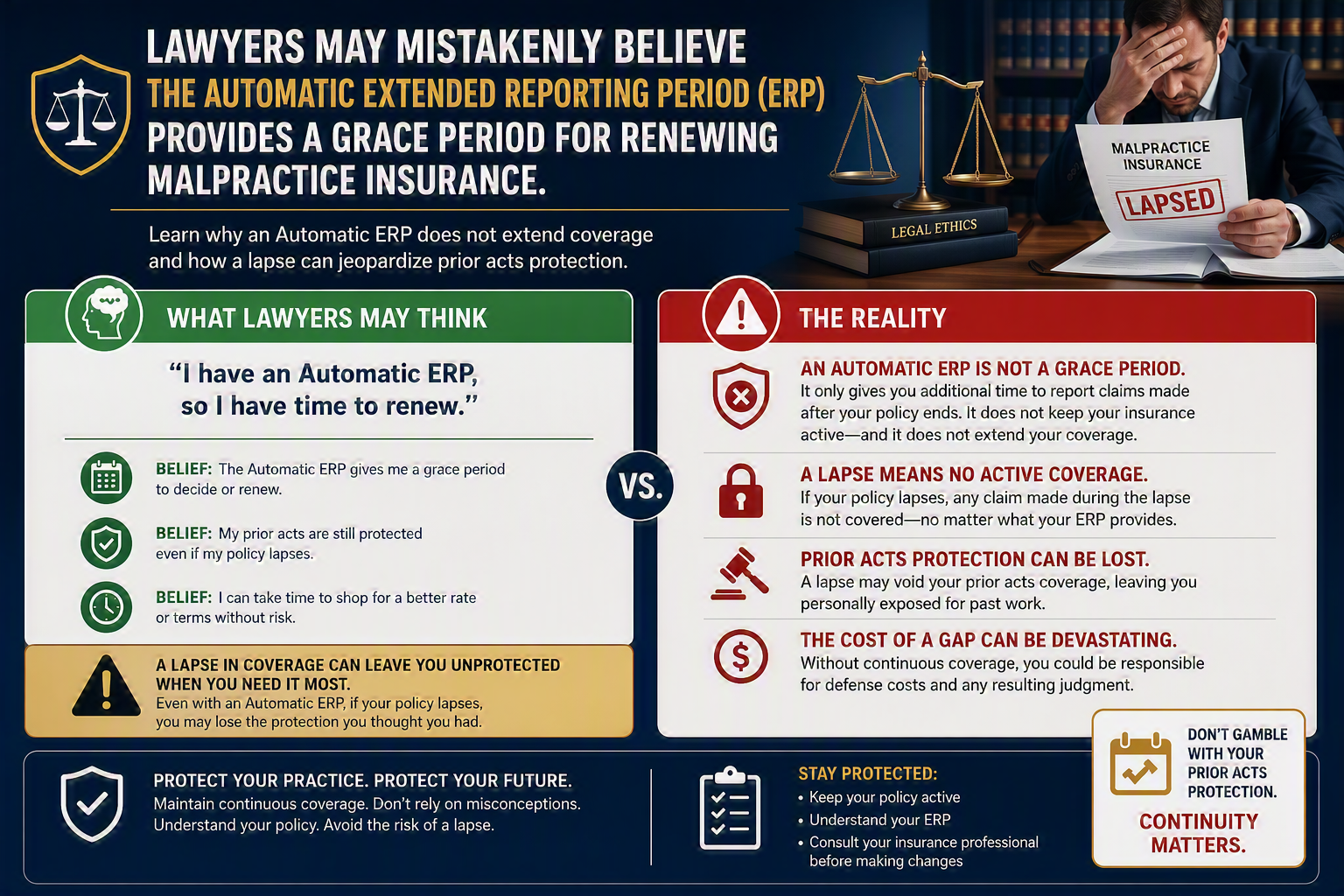
A misunderstood provision in lawyer malpractice insurance policy is the Automatic Extended Reporting Period (ERP). An attorney reviewing their policy notices a reference to a 30-day, 60-day, or similar automatic ERP and assuming it gives them additional time to renew their coverage without consequences.
Unfortunately, that assumption leads to a costly coverage mistake.
The reality is that an Automatic ERP is not a grace period, does not extend the policy period, and does not preserve uninterrupted claims-made coverage after a policy expires. In fact, misunderstanding this provision places a law firm’s prior acts coverage and financial security at serious risk.
True Story
Our insured law firm’s decision makers were on holiday at renewal time. What was not known was an unreported claim that an attorney staff member knew about. The policy lapsed. Next day the renewal application with the unreported claim arrived. The incumbent insurer underwriter withdrew renewal terms. Competing insurers withdrew terms. Firm bought an unlimited ERP at 5 times the expiring premium. Firm started new surplus-lines coverage without prior acts with an increased premium.
Understanding Claims-Made Lawyer Malpractice Insurance
Claims-made lawyer professional liability policy triggers coverage when a claim is first made and reported during the policy period, subject to the policy’s terms and conditions.
This differs from occurrence-based policies such as homeowners and general liability policies. With occurrence coverage, events occurring during the policy period continue coverage even after the policy expires. Claims-made coverage works differently. A lapse in coverage can have significant consequences because the policy’s protection depends on maintaining continuous claims-made coverage.
As a result, attorneys must pay close attention to policy expiration dates and renewal deadlines.
The Common Misconception About Automatic ERP
Lawyers may believe that if their policy contains a 60-day Automatic Extended Reporting Period, they effectively have an extra 60 days to renew their malpractice insurance.
That is not what the provision states.
Typical malpractice policy language states that the automatic ERP applies only if the insured has not obtained another LPL policy. It does not provide any coverage for acts occurring after the policy expiration date.
In other words, the provision provides a limited extension for reporting claims arising from acts that occurred before the policy expiration for the uninsured firm.
What the Automatic ERP Does Not Do
An Automatic ERP does not:
-
-
- Extend the policy period.
- Continue coverage for legal work performed after expiration.
- Create a grace period for renewal.
- Protect a law firm’s prior acts after a lapse in coverage.
- Allow attorneys to wait weeks after expiration before deciding whether to renew. ,
-
Once the policy expires, so does coverage for new work unless a new policy has been properly bound.
Why Lapses Are So Dangerous
A lapse in lawyer malpractice coverage can create two separate problems.
-
-
- No coverage for new professional services rendered after the expiration date.
- Lapses jeopardize valuable prior acts protection years in the making.
-
Law firms assuming that a tardy renewal is harmless. Do not count on the malpractice providing coverage simply because the firm intended to renew. Unless an insurer has expressly agreed in writing to extend coverage via endorsement there is no coverage.
If a claim arises during the lapse period, the consequences can be severe:
-
-
- The incumbent insurer responsiblity for reported claims ended at the policy expiration date.
- Competing insurers may withdraw or modify renewal offers.
- A newly obtained policy may exclude the matter.
- The firm ends up purchasing an expensive ERP or faces an uninsured loss.
-
Best Practices for Law Firms
To avoid coverage gaps and preserve prior acts protection:
-
-
- Begin the renewal process well before expiration, especially if being non-renewed by your incumbent insurer.
- Review loss runs and underwriting requirements early.
- Obtain and compare renewal quotes in advance.
- Bind replacement coverage before the current policy expires.
- Never assume the Automatic ERP functions as a renewal grace period.
- Understand the limited time requirements for purchasing a formal ERP if needed.
-
The Bottom Line
The phrase**”Automatic Extended Reporting Period”** sounds reassuring, but it creates a false sense of security. An Automatic ERP is not extra time to renew your malpractice insurance, nor is it a mechanism for preserving uninterrupted claims-made coverage after a lapse.
Continuous claims-made coverage matters. Missing a renewal date jeopardizes years of prior acts coverage and exposes a law firm to uninsured claims. The safest approach is simple: secure renewal or replacement coverage before the policy expires and never rely on the Automatic ERP as a grace period.
Request a Legal Malpractice Quote

Contact Me Today
Lee Norcross, MBA, CPCU
California License # 0D87292
L Squared Insurance Agency, LLC ® DBA in California as L2 L Squared Insurance Agency, License # 0L93416
Managing Director, CEO
Lee@L2Ins.com
616-726-7080