
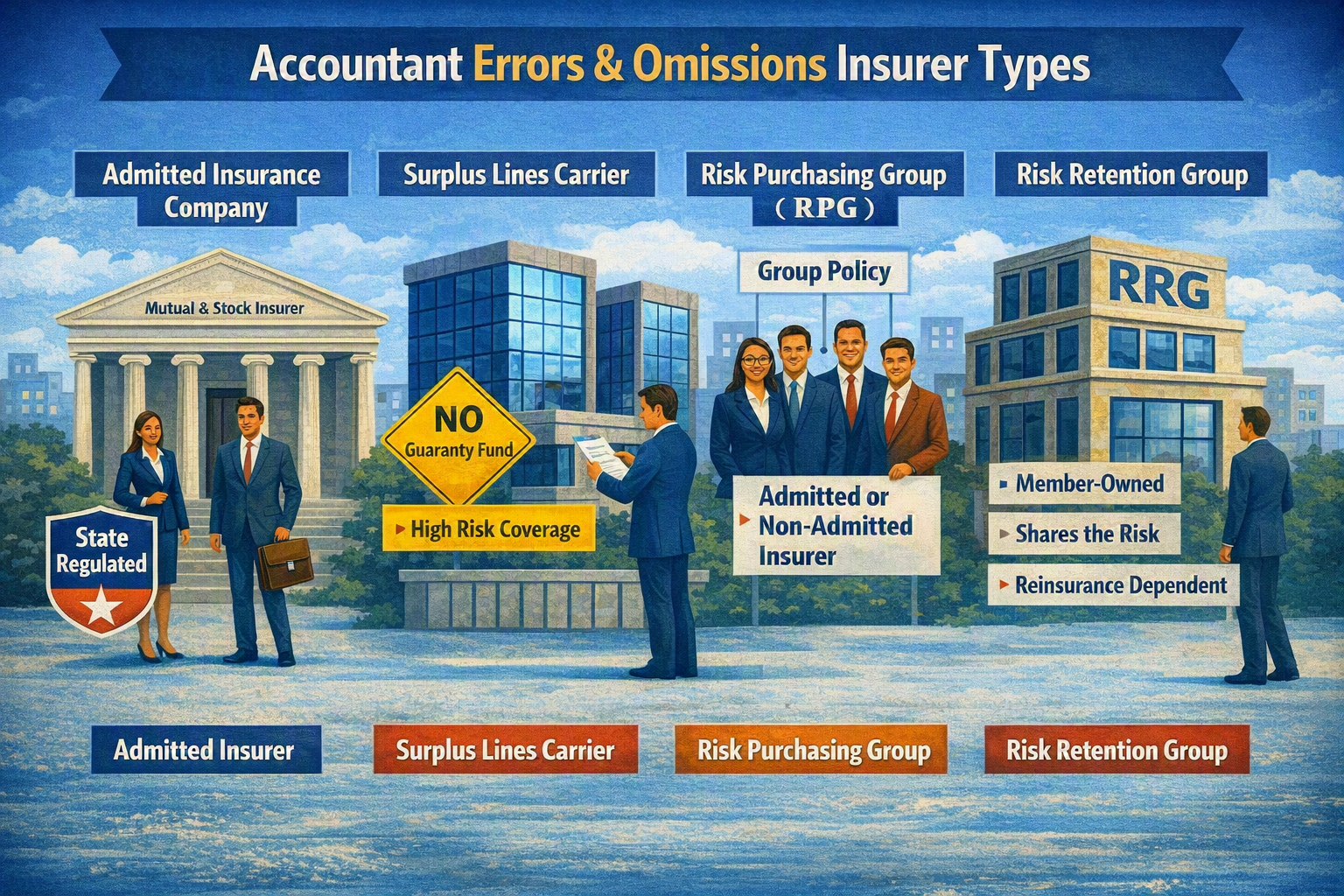
Errors and Omissions Insurer Types for Accounting Firms: Understanding Who Really Bears the Risk
When accounting firms purchase Errors and Omissions (E&O) insurance, most focus on premiums, coverage limits, deductibles, and policy terms. While these considerations are important, they represent only part of the overall risk management equation.
An equally important and frequently overlooked factor is the insurer type issuing the policy. Two E&O insurance policies may offer similar coverage language, yet the financial backing behind those policies can be significantly different. Understanding the insurer types can help accounting firms evaluate not only the purchased coverage but also the financial security supporting that coverage.
Not all insurance carriers operate under the same regulatory framework. Certain insurer types are subject to extensive state regulation and participate in guaranty funds, while others operate under alternative structures that may place additional risk on policyholders. Congress expanded access to alternative liability insurance arrangements during the liability insurance crises of the 1980s, creating options that increased availability and competition but also altered the allocation of risk between the insurer and the insured. [riskretention.org]
For accounting firms evaluating malpractice insurance, understanding who backs the coverage may be just as important as understanding what the policy covers.
Why Insurer Type Matters
An Errors and Omissions insurance policy is a financial promise.
When a client files a claim alleging that an accounting error resulted in financial harm, the policy’s value depends on the insurer’s ability to investigate, defend, and pay covered claims. For this reason, accounting firms should evaluate more than just price and coverage terms.
Factors to consider include:
-
-
- Financial strength and stability
- Regulatory oversight
- Claims-paying history
- Capital reserves and surplus
- Reinsurance support
- Long-term market experience
- Availability of state guaranty fund protection
-
These factors can vary depending on the Insurer type providing coverage.
-
-
- Admitted Mutual and Stock Insurance Companies
-
Mutual insurance companies and stock insurance companies represent the traditional insurance marketplace. Although their ownership structures differ, licensing and regulation by state insurance departments has historically served as the foundation of the professional liability insurance industry. These insurers must file policy forms and rates with regulators and participate in state insurance guaranty funds.
How Risk Backed
With an admitted insurer:
-
-
-
- The insurer assumes the underwriting risk.
- State regulators monitor financial condition and solvency.
- Policyholders benefit from extensive consumer protections.
- State guaranty funds may provide an additional safety net, subject to state-specific rules and limits.
-
-
Risk Assumed by the Accounting Firm
Among the insurer types discussed, admitted mutual and stock insurers place the least amount of carrier-related risk on the insured. Accounting firms primarily assume the risks associated with the policy’s deductibles, exclusions, and limits, while the insurer bears responsibility for maintaining financial strength and reserves. Admitted carriers remain the benchmark for financial security and regulatory protection.
-
-
- Non-Admitted (Surplus Lines) Insurance Carriers
-
Surplus lines insurers serve a key role in the insurance marketplace by providing coverage that may not be available through admitted carriers. These insurers often provide coverage for firms with unique risks, specialized services, prior claims activity, or other exposures that may not fit traditional underwriting guidelines.
Well-respected surplus lines E&O insurers operate in providing strong coverage solutions. The key difference is not necessarily the quality of coverage, but the regulatory framework in which the insurer operates.
How Risk Backed
Under a surplus lines arrangement:
-
-
-
- The insurer assumes the underwriting risk.
- The carrier operates outside the admitted market.
- State guaranty fund protections do not apply.
-
-
Risk Assumed by the Accounting Firm
Accounting firms insured through surplus lines carriers assume greater carrier-related risk because guaranty fund protections are unavailable if the insurer becomes insolvent.
Therefore, firms should place greater emphasis on:
-
-
-
- Financial strength ratings
- Industry reputation
- Management experience
- Years in operation
- Claims-paying performance
-
-
When selecting a surplus lines insurer, financial stability becomes particularly important.
-
-
- Risk Purchasing Groups (RPGs)
-
Risk Purchasing Groups emerged through federal legislation intended to address liability insurance affordability and availability concerns. Congress initially authorized these arrangements through the Product Liability Risk Retention Act of 1981 and later expanded them through the Liability Risk Retention Act of 1986. [riskretention.org], [riskretention.org]
An RPG allows businesses or professionals with similar liability exposures to purchase insurance collectively. However, a Risk Purchasing Group is not itself an insurance company. Rather, it serves as a purchasing mechanism through which members obtain liability insurance from an underlying insurer. [riskretention.org], [cicaworld.com]
How Risk Backed
Within an RPG Structure:
-
-
-
- The RPG does not retain insurance risk.
- The underlying insurance carrier bears responsibility for claims.
- Members benefit from group purchasing efficiencies. [riskretention.org], [cicaworld.com]
-
-
The insurance carrier issuing coverage through an RPG may be either an admitted or non-admitted insurer. RPGs may also charge membership fees.
Risk Assumed by the Accounting Firm
The level of risk assumed by the accounting firm depends less on the RPG and more on the actual insurance carrier providing the coverage.
When the policy is issued by a well-capitalized admitted insurer, the attorney’s risk profile may closely resemble traditional insurance. Conversely, if the underlying carrier is a non-admitted insurer, the attorney assumes the additional risks associated with the surplus lines marketplace. [riskretention.org]
Accordingly, accounts evaluating an RPG should focus on the actual insurance carrier providing the coverage rather than solely on the purchasing group.
-
-
- Risk Retention Groups (RRGs)
-
Risk Retention Groups are the most misunderstood carrier type available in the professional liability marketplace.
Unlike a Risk Purchasing Group, an RRG functions as an insurance company. Federal law permits businesses and professionals with similar liability exposures to form or participate in these organizations, which exist primarily to insure their members. [riskretention.org], [cicaworld.com], [govinfo.gov]
Policyholders often incorrectly assume an RRG is simply another insurance company operating under the same framework as traditional insurers. Differences exist.
How Risk Backed
In an RRG structure:
-
-
-
- The organization functions as an insurer.
- Members collectively participate in the risk-sharing model.
- Reinsurance plays a significant role in supporting the program’s financial stability. [cicaworld.com], [govinfo.gov],
- The group exists primarily to insure its members.
-
-
Risk Assumed by the Accounting Firm
Of the insurer types discussed, Risk Retention Groups place the greatest amount of carrier-related risk on policyholders.
Key considerations include:
-
-
-
- State guaranty fund protection does not apply.
- Reinsurance support is critical to the program’s stability.
- An RRG that loses reinsurance support may face significant operational challenges, i.e., insurance coverage may disappear without warning.
- State insurance departments have limited ability to assist policyholders compared with admitted carrier situations. [riskretention.org]
-
-
This does not mean all RRGs are financially weak. Professionally managed RRGs serve their members effectively. However, accountants considering an RRG should conduct a more detailed review of capitalization, reinsurance arrangements, governance, and financial condition than they might with an admitted insurer.
Questions Accounting Firms Should Ask Before Purchasing E&O Insurance
Before selecting an Errors and Omissions insurer, accounting firms should consider asking:
-
- Is the insurer admitted or non-admitted?
- Does state guaranty fund protection apply?
- What is the carrier’s financial strength and history?
- How long has the carrier operated in the E&O insurance marketplace?
- How dependable is the insurer in paying claims?
- Does the carrier rely significantly on reinsurance?
- If an RPG or RRG is involved, who backs the insurance risk?
- What protection exists if the carrier experiences financial distress?
The answers to these questions often reveal more about the quality of an insurance program than premium comparisons alone.
Conclusion
Errors and Omissions insurance is more than just a policy; it is a financial promise.
Admitted insurers, surplus lines carriers, Risk Purchasing Groups, and Risk Retention Groups all play important roles in the E&O insurance marketplace. However, they do not transfer risk in the same manner. The carrier structure behind a policy affects financial security, regulatory oversight, insolvency protections, and the amount of risk assumed by the accounting firm.
When evaluating Errors and Omissions insurance for accounting firms, CPA firms should look beyond pricing and policy language. Understanding the insurer standing behind the coverage can help firms make better-informed risk management decisions and ensure they have reliable protection when they need it most. [riskretention.org], [cicaworld.com]
The strength of the promise to pay is often just as important as the coverage itself.
Click here to request an E&O quote

Contact Me Today
Lee Norcross, MBA, CPCU
California License # 0D87292
L Squared Insurance Agency, LLC ® DBA in California as L2 L Squared Insurance Agency, License # 0L93416
Managing Director, CEO
Lee@L2Ins.com
616-726-7080